That occasional engine shudder, the slight dip in MPG, or the hesitant acceleration you’ve likely felt it in an older car. Often, the culprit is hidden within the fuel system: a buildup of carbon deposits on critical components like fuel injectors and intake valves. To combat this, the auto parts aisle is lined with an array of fuel system cleaners, each promising to restore power, efficiency, and smoothness with a simple pour-in treatment. But do these miracle-in-a-bottle solutions actually deliver on their claims, or are you just paying for expensive solvent?
It’s a valid and common scepticism. Many drivers view fuel additives with a wary eye, questioning if they are a necessary maintenance item or a clever marketing ploy for a problem that doesn’t exist. The truth, backed by automotive engineers and chemists, lies in the specific chemistry and application. Not all cleaners are created equal, and their effectiveness hinges on understanding both the problem they’re solving and the active agents they use to solve it.
In this expert deep dive, we move past the marketing hype to examine the hard science. We’ll explain precisely how harmful carbon deposits form in your engine, demystify how the best fuel system cleaners often utilizing a key ingredient called Polyether Amine (PEA)—function at a chemical level to remove grime, and directly address the core consumer concern: are you paying for an unnecessary additive, or can a quality cleaner be a cost-effective part of your vehicle’s maintenance regimen?
The Invisible Enemy: How Carbon Deposits Gunk Up Your Engine

The modern internal combustion engine is a masterpiece of precision engineering, operating under extreme temperatures and pressures. Yet, within this controlled chaos, an inevitable and stealthy process occurs. Each drop of fuel, despite being refined, contains hydrocarbons that do not fully vaporize or burn perfectly. Over countless combustion cycles, these unburned or partially burned hydrocarbons undergo a chemical transformation. They bake onto hot engine components, forming hard, crusty deposits primarily composed of carbon. This is not a sign of a faulty engine but a universal byproduct of its operation, accelerated by factors like frequent short trips where the engine never fully reaches optimal temperature, lower quality fuel, and specific engine designs that run hotter or with higher fuel pressures.
These carbon deposits are not a uniform nuisance. They strategically attack the most critical points in the fuel and air delivery system. The first and most vulnerable target is the fuel injector. Modern direct and port fuel injectors have microscopic nozzles designed to atomize fuel into a fine, easily combustible mist. As carbon builds up on these tiny orifices, it disrupts this perfect spray pattern. Instead of a fine mist, the fuel may squirt in uneven streams or dribble, leading to poor air-fuel mixing. This immediate and direct interference with the engine’s most fundamental process is a primary cause of performance decline.
Another critical area under siege is the intake valve. In many engine designs, fuel is sprayed onto the back of these valves, which then guides the air-fuel mixture into the cylinder. The constant exposure to both fuel droplets and hot combustion gases creates an ideal environment for deposit accumulation. These deposits act like an insulating blanket on the valve, disrupting its ability to manage heat and, more importantly, physically interfering with its seating. A valve caked with carbon cannot close fully, leading to compression loss and potentially allowing hot gases to leak backward, a condition known as backfiring.
Within the combustion chamber itself, on the tops of pistons and the cylinder head, deposits form a different kind of threat. Here, they create hot spots by trapping heat and increasing the chamber’s compression ratio. These hot spots can cause the air-fuel mixture to ignite prematurely and erratically, a phenomenon known as engine knock or ping. This uncontrolled detonation creates harsh pressure spikes that shock engine components, potentially causing damage over time. Furthermore, the physical volume of the deposits reduces the space within the combustion chamber, slightly altering the engine’s geometry and efficiency.
The cumulative effect of this carbon invasion is a cascade of performance and efficiency failures. The engine’s computer, trying to compensate for poor combustion caused by dirty injectors and leaky valves, may adjust parameters in a losing battle, often resulting in increased fuel consumption. Power delivery becomes hesitant and rough as combustion becomes inconsistent from one cylinder to the next. In severe cases, this can trigger the check engine light due to misfire detection or elevated emissions. Ultimately, what begins as microscopic layers of carbon evolves into a tangible problem that impacts drivability, your wallet at the gas pump, and the long-term health of the engine.
From Fuel to Foul: The Formation of Deposits
The journey from clean fuel to stubborn engine carbon begins with the inherent complexity of gasoline and diesel themselves. These fuels are not pure, single-molecule substances but complex cocktails of hundreds of different hydrocarbon compounds, including paraffins, olefins, and aromatics. While refined to specific standards, this mixture contains heavier, less volatile hydrocarbons that resist easy vaporization. When injected into the engine, these heavier components are the first to deviate from the ideal burn path. They are more likely to remain in liquid form for a fraction of a second longer, allowing them to contact hot metal surfaces where combustion is not intended to occur, such as the tip of an injector or the back of an intake valve. This initial contact is the seed from which deposits grow.
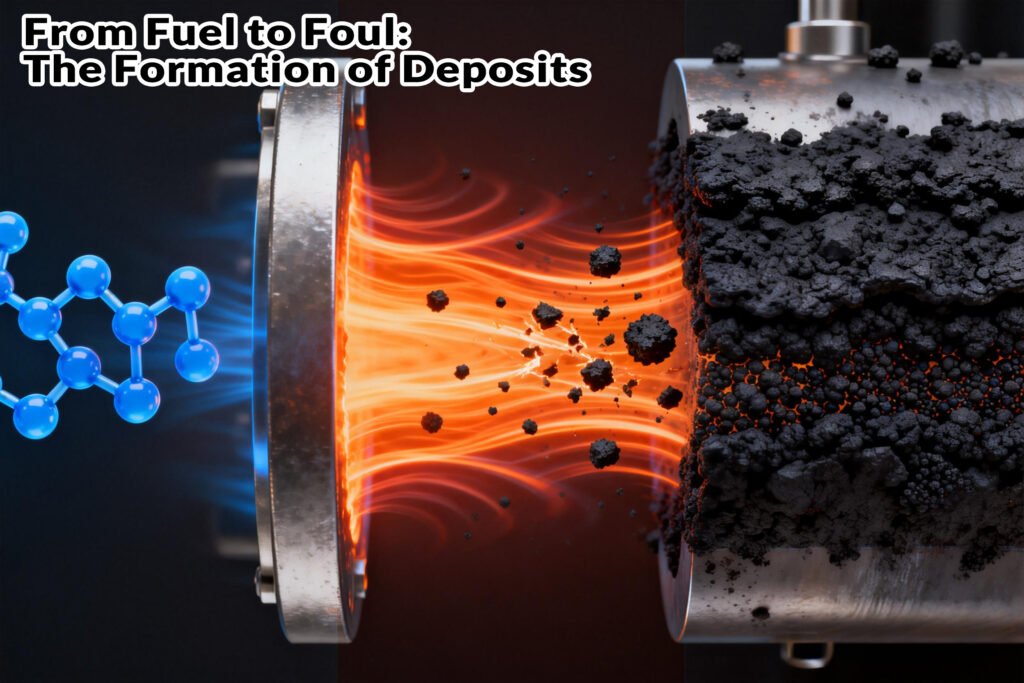
The primary chemical culprit behind the transformation from fuel liquid to solid deposit is a process known as pyrolysis. When fuel or its heavier components are exposed to intense, localized heat from the engine metal surfaces, which can far exceed the temperature of the bulk air-fuel mixture, they do not burn. Instead, in the absence of sufficient oxygen on these protected surfaces, they thermally crack and decompose. This is analogous to what happens when food is charred on a hot pan. The complex hydrocarbon chains break down, releasing lighter gases and leaving behind a solid, carbon-rich residue. This residue forms the foundational layer of a deposit, a tenacious carbonaceous film that firmly adheres to the metal.
This foundational layer then enters a cycle of growth and hardening known as coking. As more fuel is introduced in subsequent engine cycles, the existing carbonized layer acts like a sponge or a sticky lattice. It traps and captures passing droplets of unvaporized fuel, as well as other contaminants present in the combustion chamber, such as engine oil vapor that slips past piston rings or carbon particles from previous combustion events. Each exposure to the engine’s high-temperature cycle bakes this captured material further, driving off volatiles and adding more solid carbon to the matrix. Over time, this repeated process of accumulation and thermal baking builds the deposit layer by layer, much like layers of sedimentary rock form over millennia.
The rate and severity of this deposit formation are critically influenced by modern engine design and driving patterns. Engineers strive for higher efficiency, leading to engines that run at higher internal temperatures and pressures, which accelerates pyrolysis. Furthermore, the widespread adoption of Gasoline Direct Injection (GDI) technology presents a unique challenge. In GDI engines, fuel is sprayed directly into the cylinder at extremely high pressure, bypassing the intake valves. While this improves power and efficiency, it eliminates the cleansing effect of fuel washing over the back of the intake valves. These valves are instead coated only by oily vapor from the crankcase ventilation system, leading to rapid and severe deposit buildup on the valves, a notorious issue in GDI engines.
Ultimately, the deposit that forms is a complex, crust-like composite. It is not pure carbon but an amalgam of carbonized fuel, trapped oil residues, metal particles from wear, and ash from fuel additives. Its structure is porous yet incredibly adherent, bonding tightly to the microscopic pores and imperfections of the metal surface. This complex composition and strong bond are what make these deposits so detrimental to engine function and challenging to remove, transitioning from a simple fuel byproduct to a formidable enemy of engine performance.
The Toll on Performance: Symptoms of a Dirty Fuel System
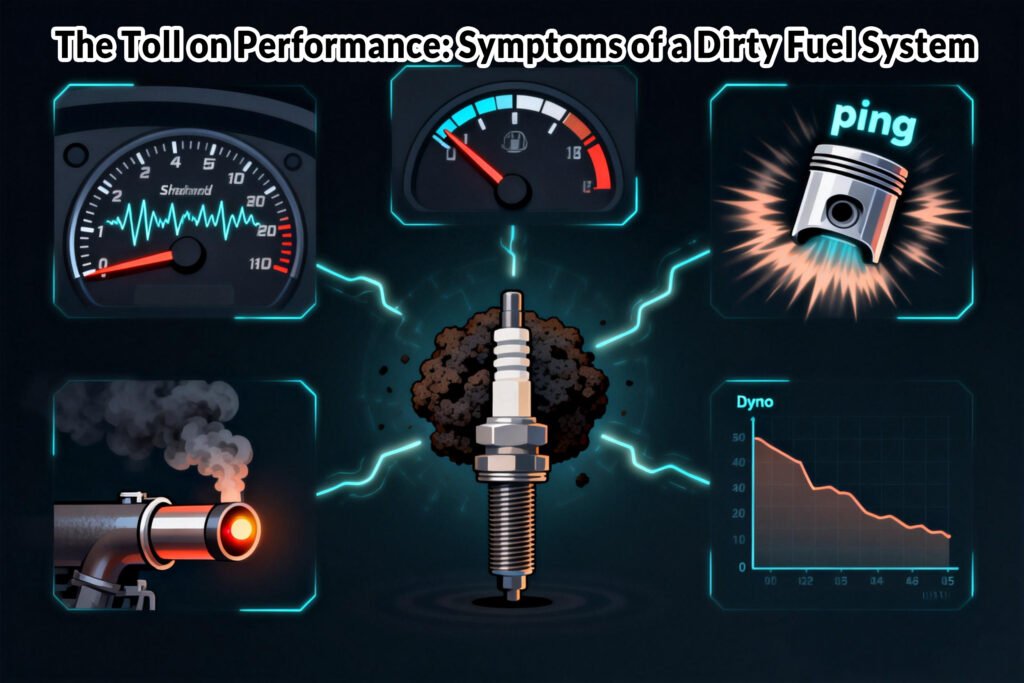
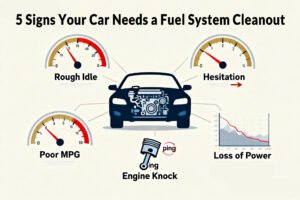
The most immediate and noticeable symptom of a fuel system compromised by carbon deposits is a distinct degradation in drivability, beginning with idle quality and throttle response. A clean engine should idle with a smooth, consistent hum. When injectors are fouled and spray patterns are distorted, the engine’s computer struggles to maintain perfect balance. This results in a rough, uneven idle that may feel like a subtle shake or vibration through the steering wheel and seats. Furthermore, the moment you press the accelerator, the engine may hesitate or stumble before power builds. This occurs because the compromised injectors cannot deliver the precise, immediate burst of fuel required for crisp acceleration, creating a frustrating lag in throttle response.
A direct hit to your wallet comes in the form of diminished fuel economy. This decline in miles per gallon is a logical consequence of inefficient combustion. Dirty injectors delivering poorly atomized fuel and intake valves that cannot seal properly lead to incomplete burning of the air-fuel mixture. Essentially, some of the gasoline pumped into the cylinders does not get converted into useful energy; it is wasted. The engine’s computer, detecting issues like lean conditions or misfires from poor combustion, may also overcompensate by enriching the fuel mixture, dumping in even more gasoline to attempt to stabilize the engine, thereby compounding the fuel waste. The result is more frequent visits to the gas station for the same amount of driving.
Over time, the problem escalates from poor efficiency to potential mechanical distress, most notably through engine knock or ping. This alarming metallic pinging sound during acceleration is caused by uncontrolled combustion. Carbon deposits in the combustion chamber create hot spots and raise compression. These hot spots can ignite the air-fuel mixture prematurely, before the spark plug fires, causing a second, erratic pressure spike that clashes with the normal force of the piston’s upward travel. This detonation creates immense, damaging shock waves within the cylinder. While modern engine management systems can detect and attempt to retard timing to mitigate knock, this adjustment comes at the cost of further reducing power and efficiency, and persistent severe knock can lead to piston and bearing damage.
The vehicle’s emissions control system also suffers under the burden of a dirty fuel system. Incomplete combustion produces a significant increase in harmful exhaust pollutants. Key among these are unburned hydrocarbons and nitrogen oxides. The engine’s oxygen sensors and the vehicle’s catalytic converter are designed to handle a certain level of these byproducts, but a chronically misfiring or inefficiently running engine can overwhelm them. This not only increases the vehicle’s environmental impact but can also cause the check engine light to illuminate due to catalyst efficiency or oxygen sensor codes. In many regions, this will cause the vehicle to fail mandatory emissions testing until the underlying combustion issue is resolved.
Finally, the cumulative toll manifests as a general loss of power and refined performance. An engine suffering from carbon fouling feels lethargic and unenthusiastic. It may struggle during highway merging, feel bogged down when climbing hills, or simply fail to deliver the smooth, linear power band it once did. This is the sum of all the individual issues: reduced volumetric efficiency from clogged intake paths, the engine computer pulling ignition timing to fight knock, and the fundamental energy loss from fuel that fails to burn completely. What was once a responsive machine becomes dulled, signalling that the invisible enemy of carbon has successfully entrenched itself and is actively degrading the engine’s core function.
The Chemistry of Clean: How Fuel System Cleaners Function
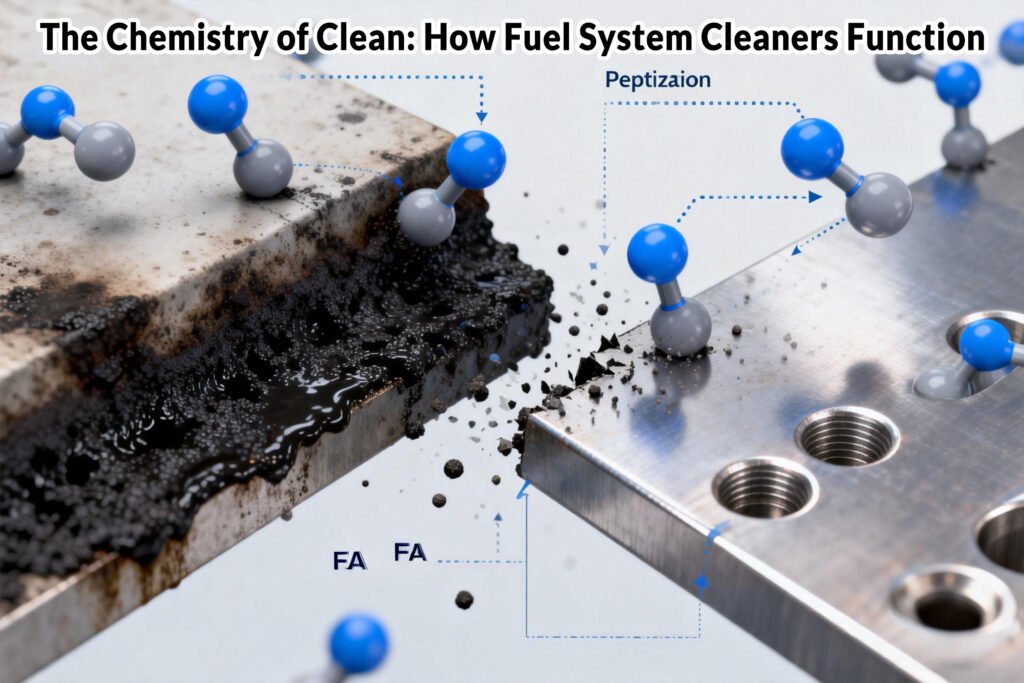
To understand how a quality fuel system cleaner works, one must first appreciate the formidable nature of the enemy it targets. Carbon deposits are not a simple, loose soot that can be rinsed away. They are a hardened, baked-on composite of carbonaceous material tightly bonded to metal surfaces. Ordinary gasoline has some detergent properties, but they are mild and designed for basic maintenance, not for removing established, stubborn deposits. Effective fuel system cleaners are therefore highly concentrated, specifically engineered chemical solutions designed to attack these deposits through a combination of advanced chemistry and physical action. Their function is a deliberate, multi-stage process that occurs on a molecular level as the treated fuel circulates through the entire system.
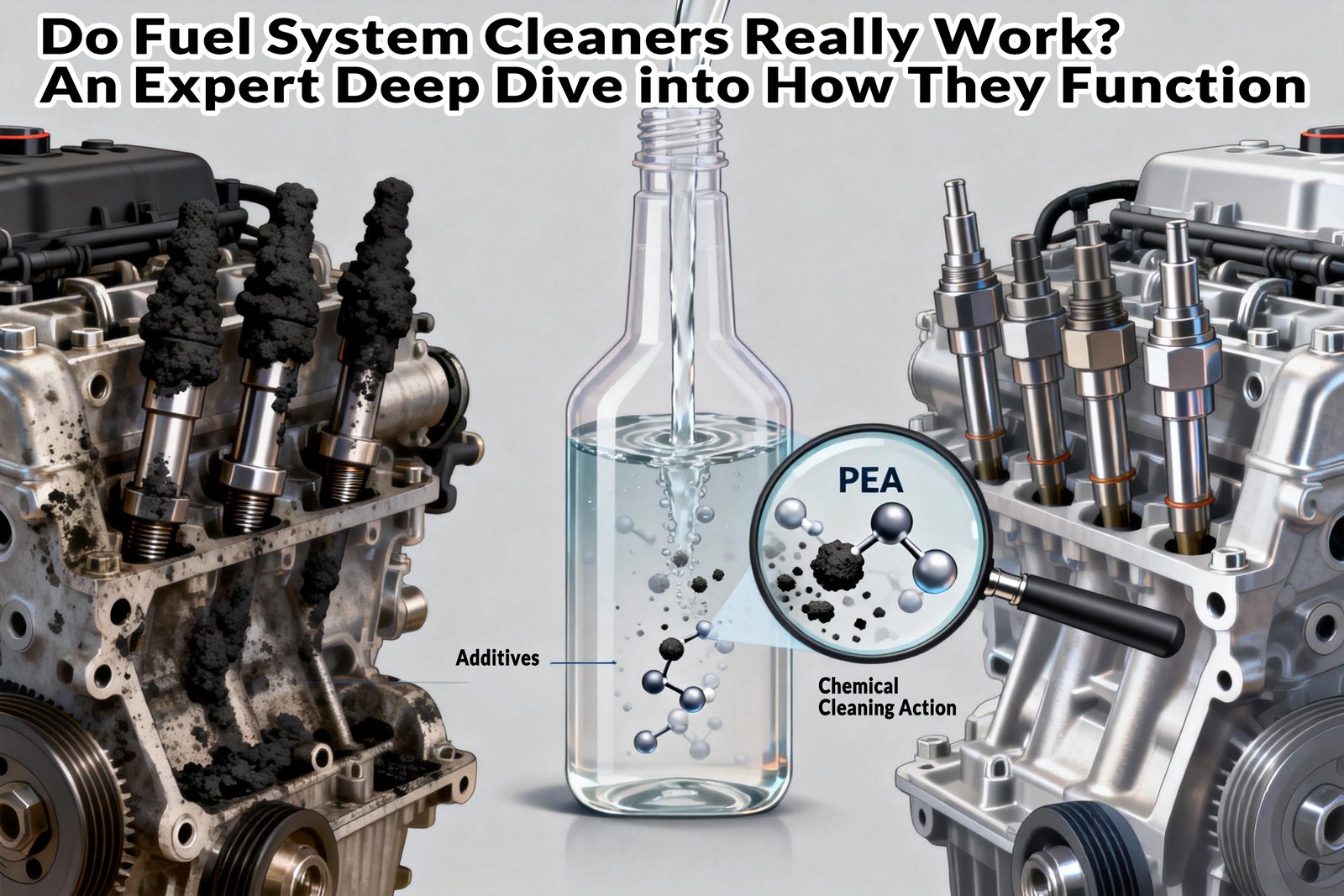
At the heart of most top tier fuel system cleaners is a category of chemical compounds known as polyether amines, commonly referred to as PEA. This molecule is the workhorse of modern deposit removal. Its effectiveness stems from its unique dual nature. One end of the PEA molecule is polar, meaning it has a strong attraction to the polar metal surfaces of engine components. The other end is a long, hydrocarbon chain that is oil loving, or lipophilic. This structure allows PEA to act as a supremely effective surfactant and detergent. When added to the fuel, its polar head is drawn to the metal surface beneath the deposit, while its long tail interacts with the carbon matrix itself. This action begins to reduce the adhesion between the deposit and the engine component, a critical first step.
The primary mechanical action of these chemicals is known as peptization. This is the process of breaking down a cohesive solid into fine, suspended particles. The detergent molecules, like PEA, do not dissolve the entire deposit in one piece. Instead, they adsorb onto the surface of the carbon deposit and work to penetrate its porous structure. As they wedge themselves between the deposit and the metal substrate, they gradually lift the deposit from its anchor points. Simultaneously, the hydrocarbon loving tails of the molecules work to solubilize, or break the chemical bonds within, the tarry, oily components of the deposit. This one two punch of lifting and solubilizing converts the monolithic crust into microscopic particles and soluble compounds.
These newly liberated particles and compounds are then safely transported away by the flow of the treated fuel. The combustion chamber serves as the final disposal site. The now tiny particles, suspended in the fuel and air mixture, are carried into the cylinder where they are incinerated during the normal combustion process. They are expelled with the exhaust gases. This is a key design principle of a proper cleaner; it must not only remove the deposit but also ensure its byproducts are small enough to burn completely without causing secondary damage or clogging other parts of the system, such as the catalytic converter. The entire process from adsorption to combustion is gradual, requiring the cleaner to remain in contact with the deposits over an extended period, which is why treatments are designed to work over the course of a full tank of fuel.
It is crucial to distinguish this chemical cleaning process from simple solvent action. Harsh, aggressive solvents can sometimes dissolve deposits but risk damaging sensitive elastomer seals and hoses within the fuel system. They may also drop large, uncleaned chunks of material that could cause blockages. The chemistry in a balanced, professional grade cleaner like those using high concentrations of PEA is selective and controlled. It prioritizes the breakdown of the carbon based deposits while being compatible with modern fuel system materials. Its function is not a violent stripping but a persistent, intelligent disassembly of the deposits at a molecular level, restoring cleanliness and function without compromising the integrity of the engine’s components.
Conclusion
The evidence from both chemical principles and practical application confirms that high-quality fuel system cleaners, specifically those utilizing concentrated Polyether Amine (PEA) chemistry, do indeed perform a valuable and measurable function. They are not mythical cure-alls, but rather targeted chemical tools designed to address a specific, well-understood engineering problem: the gradual accumulation of carbon deposits. Their mode of action peptization through surfactant action, followed by the suspension and combustion of deposit particles is a legitimate and engineered process that can restore lost performance and efficiency when used correctly on a mildly to moderately fouled engine.
Therefore, the consumer concern about paying for unnecessary additives is valid but requires nuanced consideration. For a new vehicle or one regularly driven on long highway trips with top-tier fuel, they may be prophylactic. However, for the majority of vehicles exhibiting the symptoms of deposit buildup rough idle, hesitation, or decreased fuel economy a quality cleaner is not an unnecessary expense but a cost-effective form of maintenance. It represents a fraction of the cost of mechanical cleaning procedures like media blasting or walnut shell blasting for intake valves, offering a legitimate first-line defense.
Ultimately, a premium fuel system cleaner is best viewed as a reliable component of a proactive maintenance strategy. When selected based on proven active ingredients like PEA and used according to directions, it serves as a potent preventative measure and an effective restorative treatment. By understanding the science behind both the problem and the solution, drivers can move beyond skepticism and make an informed decision, using these chemicals not as a hope-in-a-bottle but as a calculated and effective tool for preserving engine health, performance, and efficiency.
Frequently Asked Questions
1. Are fuel system cleaners just “snake oil,” or do they actually work?
While many inexpensive, generic additives offer minimal benefit, high-quality fuel system cleaners that contain a high concentration of specific chemicals like Polyether Amine (PEA) are scientifically formulated to work. They are designed to gradually dissolve and disperse the carbon deposits that naturally form on fuel injectors and intake valves, leading to measurable improvements in drivability, fuel economy, and emissions when used as directed on a fouled engine.
2. Can a fuel system cleaner damage my engine or catalytic converter?
A properly formulated cleaner from a reputable brand is designed to be safe for all engine components, including oxygen sensors and the catalytic converter. The cleaning process breaks deposits into microscopic particles that are safely burned away during normal combustion. However, using excessively harsh solvents or improper doses of off-brand products can pose risks. Always follow the manufacturer’s instructions.
3. How often should I use a fuel system cleaner in my car?
For preventative maintenance, using a quality cleaner every 3,000 to 5,000 miles is a common recommendation. This helps prevent significant deposit buildup from occurring. If you are treating an existing problem like rough idle or hesitation, a single concentrated treatment can be effective, followed by a regular preventative schedule. Always consult your vehicle’s owner’s manual for any specific guidance or warnings.